Have you ever walked inside the store, and grabbed a shirt in a color you love the most, but the moment you put it on in the trial room, you feel and look… tired? Or perhaps you’ve worn a shade which you ignore, only to have everyone tell you how “radiant” you are looking today.
This is not magic, it’s color theory.
Color is a direct tool that we use to communicate. Before you even speak, the colors that you are wearing tell a story. In a world of fashion, choosing the right color palette can make a whole difference between feeling washed out and looking like the best version of you.
In fact, one study shows that between 62% to 90% of a first impression is based on color alone.
When you wear a color that blends with your natural features, you aren’t just wearing an outfit, but you’re creating a visual “glow” – but why is it too hard to get right?
The reason is: Most of us shop for colors we like, rather than the colors that like us. Considering that 85% of consumers cite color as the primary reason they buy a specific cloth, understanding the science behind it is the ultimate shopping goal to crack.
Skin Tone vs Undertone: What Does the Difference Say?
The first major step in mastering color theory is knowing that your “skin tone” and your “undertone” are two different things.
- Skin tone – This is the color you see in the mirror. It is described in a general sense as being fair, light, medium, tan or deep – and can change depending on the season, how much sun you’ve had, or even based on your health.
- Undertone – This is the permanent hue present under the surface of your skin; it never changes, regardless of whether you have a tan or not. This is the hidden ingredient that determines whether a specific blue will look “electric” or “depressing” on you.
The Three Major Types of Undertones
- Warm – Your skin has hints of peach, yellow or gold.
- Cool – Your skin has hints of pink, red or blue.
- Neutral – You have a mix of both, or your undertone is quite close to your surface tone.
Interestingly, one study suggests that up to 68% of the population falls into the neutral category that said, they have a neutral undertone.
However, the majority of them lean slightly one way or the other.
How To Find Your Perfect Undertone?
Seeking professional help for this is not necessary. You can do it right away with a few simple tests.
Make sure you are in natural light to receive the most accurate results.
The Vein Test
Look at the veins on the inside of your wrist.
- If your veins look greenish, you are having a warm undertone because the yellow in your skin makes the blue veins look green.
- Whereas, if your veins look blue or purple, you likely have cool undertones.
- But, if you can’t identify, or if they feel teal, you are likely neutral.
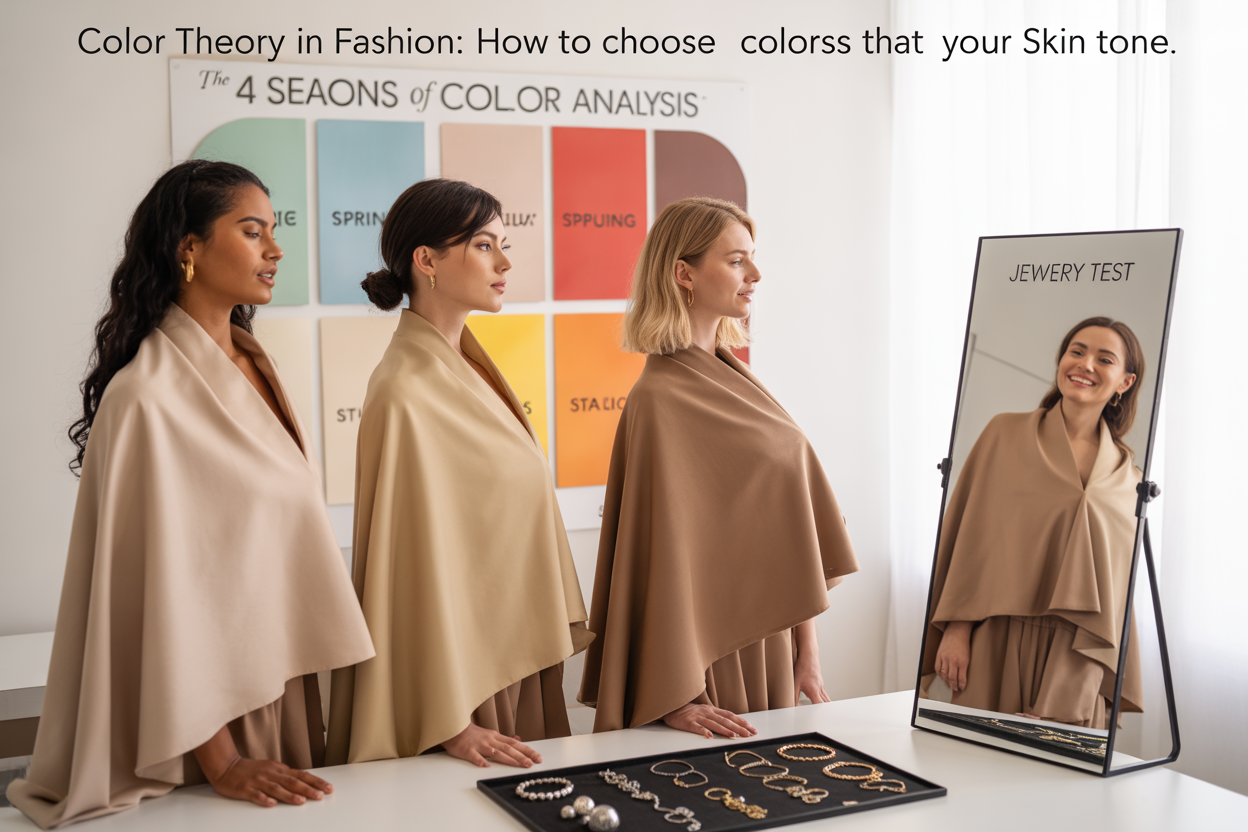
The Jewelry Test
Think about which metal makes your skin look “alive.”
- If Gold makes it look radiant and healthy, you’re warm.
- If it glows while wearing silver or platinum jewelry, you’re cool.
- But if you wear both effortlessly, you are neutral.
The White Paper Test


Hold a piece of whiter paper up to your bare face.
- If your skin looks yellow or swollen next to the paper, you’re warm.
- Whereas, if it looks pinkish or rosy, you’re cool.
- If you look a bit grey or ashen, you might be neutral.
The 4 Seasons of Your Color Analysis
Once you understand your undertone, you can categorize yourself into one of the “Four Seasons.” This is the gold standard of fashion styling.
Spring (Warm + Light)
Spring has fair-to-medium skin with a golden undertone. Their hair often has hints of honey, strawberry blonde, or golden brown.
- Your Palette – Consider it as a blooming garden. Bright, clear and warm colors like coral, peach, turquoise and “grass” green.
- Neutrals – Ivory and warm camel.
Autumn (Warm + Deep)
Autumns have a rich, golden quality. Their skin might have a “glow” to it, and their hair often has red, auburn or a deep golden-brown tone.
- Your Palette – Think of a forest in the month of October. Deep earth tones like an olive green, a burnt orange, mustard yellow and a chocolate brown.
- Neutrals – Rich creams and warm beige.
Summer (Cool + Light)
Summers have a soft and delicate look. Their skin has blue or pink undertones, and their hair is often ash-blonde or light “mousy” brown.
- Your Palette: Think of a hazy, cool morning. Muted, soft colors like lavender, dusty rose, sky blue, and “cool” mint green.
- Neutrals: Slate grey and soft navy.
Winter (Cool + Deep)
Winters have a lot of contrast. This often looks like very fair skin with dark hair, or very deep skin with a cool, blueish undertone.
- Your Palette: Think of a snowy night. Bold, jewel tones like royal blue, emerald green, fuchsia, and “true” red.
- Neutrals: Stark white and jet black. (Winters are the only season that can truly pull off pure black without looking washed out).
- Color Harmony Chart
Use this table to quickly identify your best “Power Colors” and which shades might be “Danger Colors” that wash you out.
| Season | Your Undertone | Your “Power Colors” | Colors to Avoid |
| Spring | Warm / Yellow | Peach, Coral, Golden Yellow | Stark Black, Dusty Grey |
| Summer | Cool / Blue | Lavender, Sky Blue, Rose | Burnt Orange, Mustard |
| Autumn | Warm / Golden | Olive, Burnt Orange, Terracotta | Icy Blue, Neon Pink |
| Winter | Cool / Pink | Emerald, Royal Blue, Magenta | Beige, Earthy Browns |
How to Build Your Signature Palette
Understanding your season doesn’t mean you can never wear your favorite color again. It just means you need to find the right version of that color.
For example, everyone can wear red.
- A Spring should choose a bright, poppy red.
- An Autumn should choose a deep, tomato red.
- A Summer should choose a soft, raspberry red.
- A Winter should choose a sharp, “true” ruby red.
By sticking to your season’s “version” of a color, you ensure that the clothes are highlighting your face rather than competing with it.
When you get this right, you’ll notice that you need less makeup and your eyes look brighter. You are essentially using the science of light to your advantage.
The Confidence of Color
Color theory isn’t about following a set of strict rules; it’s about empowerment. When you know which colors make you look your best, you shop with more intention, save money on clothes you’ll never wear, and walk into every room with a built-in sense of confidence.
Whether you’re a “Winter” looking for the perfect black suit or a “Spring” hunting for a coral dress, remember that the goal is to make you the star of the show.
Fashion is a language, and color is the loudest word in your vocabulary. Use it wisely, and the world won’t be able to look away.
Frequently Asked Question
Can my “Season” change if I dye my hair?
Your undertone stays the same, but changing your hair color can shift how much contrast you have, potentially moving you between sub-categories.
Does a tan change which colors look best on me?
A tan only changes your surface tone, but your warm or cool undertone remains constant, meaning your primary power colors won’t change.
What if I absolutely love a color that is “bad” for my skin tone?
Wear it away from your face! Use “wrong” colors for pants, skirts, or shoes, and keep your “power colors” for shirts and scarves.
How do I choose the right white for my skin tone?
Cool seasons (Summer/Winter) look best in crisp, optic white, while warm seasons (Spring/Autumn) look much healthier in ivory, cream, or off-white.